Engineered Arts AmecavsUnitree Robotics H1
Side-by-side comparison of Engineered Arts Ameca and Unitree Robotics H1: specs, price, use cases and SDKs.
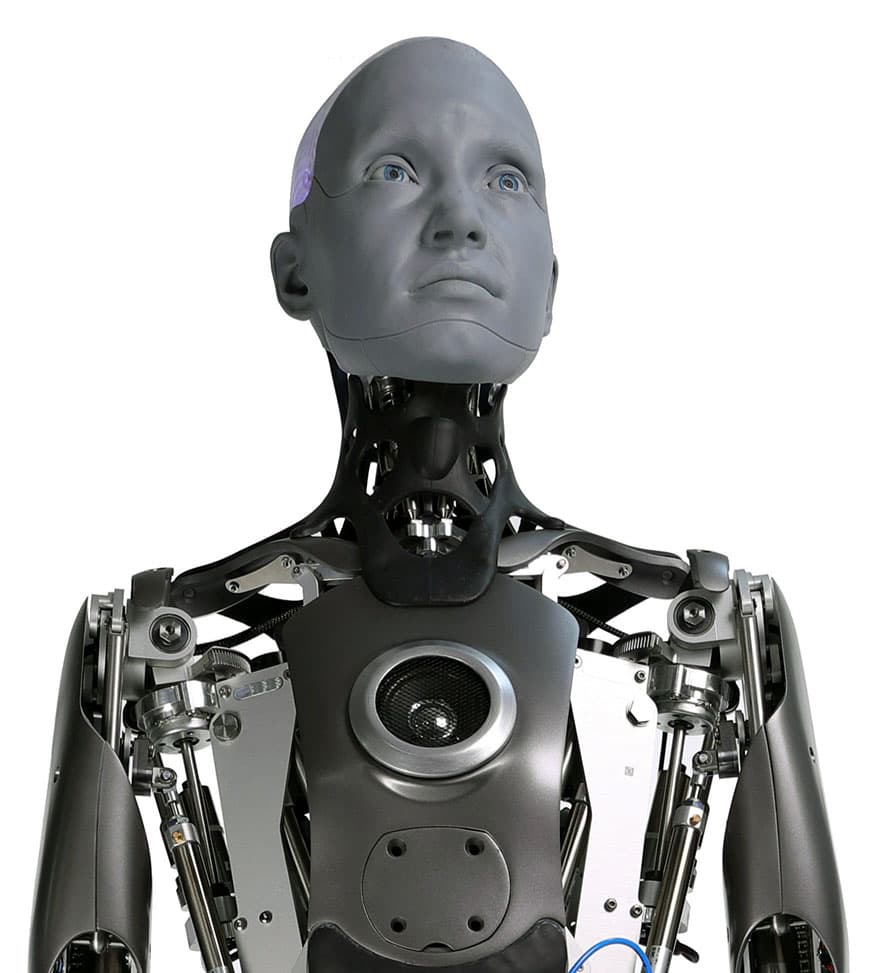
Ameca
Hyper-realistic humanoid face + upper-body for HRI research

H1
Sub-$100K Chinese humanoid — fastest walker in class
Specifications
| Spec | Ameca | H1 |
|---|---|---|
| Price (USD) | $175,000 | $90,000 |
| Category | humanoid | humanoid |
| Payload | — | 30 kg |
| Runtime | — | 2 h |
| Speed | — | 3.3 m/s |
| Weight | 50 kg | 47 kg |
| Reach | Upper-body humanoid | — |
| Degrees of Freedom | 51 | 19 |
- HRI research
- Museum / theme park installations
- Brand activations
- Film + TV
- Humanoid robotics research
- Industrial R&D
- Content creation / film
- Robotics competitions
When to pick which
Choose the Engineered Arts Ameca for high-traffic public-facing environments like science museums, theme parks, or luxury retail flagship stores where social engagement is the primary KPI. With 51 degrees of freedom concentrated in the face and upper body, Ameca excels at non-verbal communication and hyper-realistic facial expressions that the Unitree H1’s functional design cannot replicate. Research labs focused on Human-Robot Interaction (HRI) or social psychology should prioritize this platform for its seamless LLM integration via Tritium OS. When the deployment goal is to simulate human presence or provide an uncanny valley-breaking interface for film and television, Ameca’s specialized hardware justifies the $175,000 investment.
Opt for the Unitree Robotics H1 for industrial R&D centers and academic labs focused on bipedal locomotion, navigation, and full-body dynamics. At $90,000, it offers a cost-effective entry point for fleet-scale testing or robotics competitions where physical agility is paramount. The H1’s 3.3 m/s walking speed—the fastest in its class—and 30kg payload capacity make it suitable for testing autonomous delivery or warehouse inspection tasks. Developers requiring deep hardware control will benefit from the open-source Unitree SDK and ROS2 drivers, allowing for custom gait development and sensor fusion that the more proprietary, interaction-focused Ameca does not prioritize.
Ready to evaluate?
Request a vendor quote or compare more options.