SAP and Cyberwave move Physical AI from warehouse pilot to live logistics work
SAP and Cyberwave have moved warehouse robotics into a live SAP logistics operation, which makes this more interesting than a normal robotics demo. The companies say fully autonomous, AI-powered robot
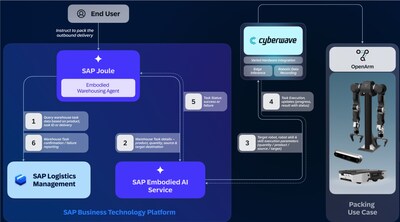
SAP and Cyberwave have moved warehouse robotics into a live SAP logistics operation, which makes this more interesting than a normal robotics demo. The companies say fully autonomous, AI-powered robots are operating inside SAP's St. Leon-Rot logistics warehouse in Germany.
The May 11 announcement says the deployment runs on SAP Logistics Management, or LGM, SAP's cloud-native logistics execution solution. The robots are performing box folding, packaging and shipping fulfillment tasks fully autonomously, with the work integrated through SAP Business Technology Platform and the Cyberwave platform.
For enterprise buyers, the important part is integration. Warehouses do not buy robots in isolation; they buy throughput, traceability and exception handling. SAP says tasks are translated into robot commands through SAP Embodied AI Service, enabling the warehouse execution layer to coordinate physical work rather than simply report inventory status.
Cyberwave's role is the robot learning and orchestration layer. The company says its platform helps operators collect training data through demonstration interfaces, fine-tune vision-language-action and reinforcement-learning models, and deploy those models on physical robots with real-time feedback. In practical terms, the pitch is that robots can adapt to high-variability warehouse tasks without weeks of custom engineering for every object or workflow.
That matters because logistics robotics is hard for reasons that are not obvious in lab videos. Boxes vary in shape and orientation. Labels, packing material, carts and work surfaces change. Shipping cutoffs compress time windows. A useful robot has to fit the warehouse's digital process and recover from physical variation.
SAP is also using its own warehouse as the reference implementation. That lowers the credibility gap: the same enterprise software company selling the integration layer is testing Physical AI in its internal logistics operation, not only presenting a partner slide.
RoboHub buyers should evaluate this as an enterprise automation architecture: SAP LGM and BTP as the digital backbone, SAP Embodied AI Service as the command translation layer, Cyberwave as the robot training and execution platform, and physical robots as the final actuator.
The procurement questions are clear: what robot hardware is supported, how exception handling works, what level of human supervision remains, whether VLA/RL models can be audited, what security controls protect warehouse data, and how quickly a new task can be taught and validated in production. If those answers hold up, this is a serious signal for Physical AI inside SAP-heavy warehouses.
Need this kind of robot for your operation?
Send us the use case. We return a vendor-neutral shortlist, indicative pricing, and warm vendor contacts within 48 hours.