Engineered Arts AmecavsUnitree Robotics H1
Side-by-side comparison of Engineered Arts Ameca and Unitree Robotics H1: specs, price, use cases and SDKs.
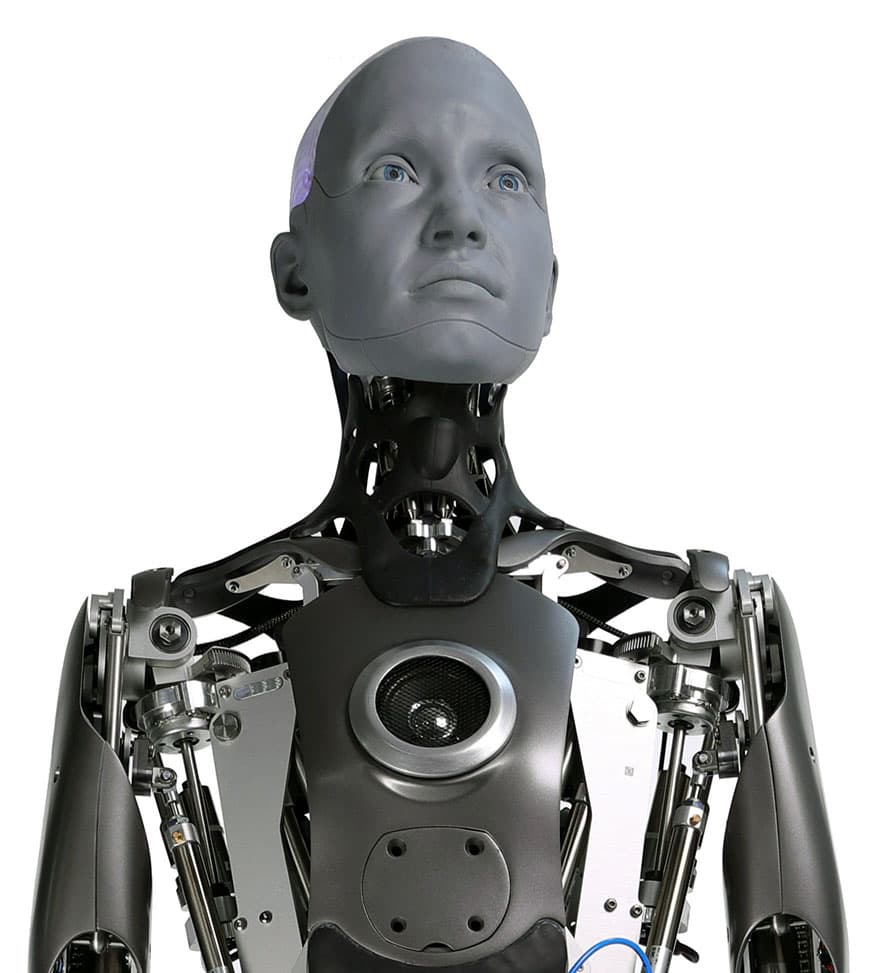
Ameca
Hyper-realistic humanoid face + upper-body for HRI research

H1
Sub-$100K Chinese humanoid — fastest walker in class
Specifications
| Spec | Ameca | H1 |
|---|---|---|
| Price (USD) | $175,000 | $90,000 |
| Category | humanoid | humanoid |
| Payload | — | 30 kg |
| Runtime | — | 2 h |
| Speed | — | 3.3 m/s |
| Weight | 50 kg | 47 kg |
| Reach | Upper-body humanoid | — |
| Degrees of Freedom | 51 | 19 |
- HRI research
- Museum / theme park installations
- Brand activations
- Film + TV
- Humanoid robotics research
- Industrial R&D
- Content creation / film
- Robotics competitions
When to pick which
Choose the Engineered Arts Ameca for high-visibility public-facing deployments where social engagement and emotional expression are the primary KPIs. In museum installations or luxury brand activations, Ameca’s 51 degrees of freedom—concentrated in its hyper-realistic facial actuators—enable nuanced non-verbal communication that lower-fidelity humanoids cannot replicate. Research institutions focusing on Human-Robot Interaction (HRI) should prioritize this platform for its seamless LLM integration via Tritium OS, allowing for sophisticated conversational AI testing. While the $175,000 price point is higher, the investment is justified for tasks requiring maximum psychological presence and lifelike interaction rather than locomotive agility.
Opt for the Unitree Robotics H1 for industrial R&D or robotics competitions where mobility and cost-efficiency are paramount. At $90,000, it offers a full-body mobile platform at nearly half the cost of the Ameca, making it suitable for labs needing to deploy multiple units for swarm or collaborative research. Its 3.3 m/s walking speed and 30kg payload capacity make it a superior choice for testing autonomous navigation in dynamic environments or light material handling tasks. Developers requiring deep hardware control will benefit from the open-source Unitree SDK and ROS2 drivers, facilitating rapid prototyping of bipedal locomotion algorithms that the upper-body-focused Ameca cannot perform.
Ready to evaluate?
Request a vendor quote or compare more options.